


For All the Saints...
- Barbara Fasig
- Nov 6, 2025
- 4 min read
Updated: Jan 17
A sermon for All Saints Sunday by the Reverend Randi Hicks Rowe.
All Saints' Day, which we’re celebrating today, allows us to reflect on how, as holy people through our baptism and seal of the Holy Spirit, we live our Christian life in unity with God and others across time and in the present moment.
As Christians, we seek to live with Christlike empathy toward those who lack the resources to buy food or shelter, or who grieve losses, or who fear tomorrow. We also seek to live as Christ did, even when our actions make us unpopular with culture. We aim to follow Christ, just as our ancestors, the holy people of this place in previous generations, followed Christ.
I invite us as we sit in this place, which has been consecrated as a church since the 1600s, to consider how those before us lived into their holy calling, and how that impacts us today.
First, a group of holy people -- saints like us met at Rosegill in 1666 to approve a church building here. English settlers had only been here in what was then part of Lancaster County for 20 years. Wars with Native Americans still occurred regularly, and times were tough, as large numbers of English settlers died. The original church, a clapboard structure, likely would have been cold in winter and hot in summer. Yet, despite all those challenges, our ancestors considered following Jesus to be essential, and worshipped here on this site.
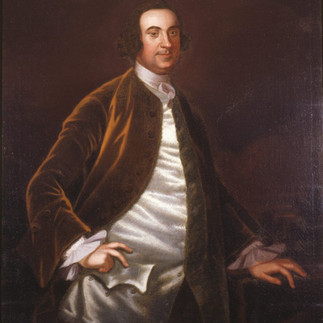

Founder Ralph Wormeley IV, his wife, Jane Bowles Wormeley, and their son, Ralph Wormeley V. Beginning with our church founders, Christ Church parishioners and their families, saints like us, have kept the faith and held our church together.
In the early 18th century, a better building was erected – this time of brick. Our current building occupies the same ground as the 1714 church. Rosegill and other plantations developed, and racial and economic factors led to divisions. However, Colonial church vestries, which had the power to tax, collected monies to support the poor and orphans.
Saints from all segments of society would have attended Christ Church then, just as now, although each social group would have its own place and role. During the Colonial era, the Gospel was proclaimed here and lived out here, just as it is today.
Divisions arose during the Revolutionary War, with some individuals identifying as patriots and others remaining loyal to the Crown. Christ Church was disestablished during this time and fell into disrepair.
We could think of this time as an exile of sorts – similar to what Judah faced – when its people weren’t able to worship in the Temple. However, just as with Judah, many of our ancestors found ways to worship God in their homes during this time and prayed for the restoration of the church. And, God did restore Christ Church, just as God provided for the rebuilding of the Temple when Judah returned from exile. God was faithful to the remnant of God’s people – our ancestors here, just as God was faithful to the remnant of God’s people in Judah.
The latter 18th century and early 19th century brought additional challenges. In the 1790s, Christ Church was led by a rector whose ministry brought shame and dishonor to the church. Although the church suffered, it survived due to the faith of the holy lay saints of that era. The American Civil War would have brought times of occupation by Northern forces. The plantation system would soon cease to operate, evolving into a system of sharecropping. Other industries would develop, such as milling, shipping, and carpentry. Our ancestors continued their faithfulness, despite social and cultural upheavals and difficulties.
The 20th century would bring many changes to the country and to Middlesex County, yet faith in Jesus and love for fellow citizens continued in this place. Affordable, comprehensive secondary education was rare during the 1920s and the parish felt a call to ensure more people could access this education. That call led to the parish giving land for the creation of Christchurch School. The church’s leadership and demographics also underwent some changes as women and minorities gained more rights on the national level. Middlesex also became a summer residence for many, and those residents took their place alongside locals as our ancestors, sharing their faith in this place.
When we 21st-century saints worship and use our resources to help others in this place, we unite across time with saints who have gone before us. We share their trials and tribulations, as well as their times of celebration. When we bring others to church with us and give our time and money to support the needy, we also unite with them in this time. We, the saints of Christ Church, are part of something great that transcends time. The Rev. Dr. Sarah Birmingham Drummond, the founding dean of Andover Newton Seminary at Yale Divinity School writes that the image of the cross “takes on new significance when one considers the perspective on time and space proposed in Ephesians. The vertical beam suggests unity with God, above, and ancestors, below. The horizontal beam signifies unity with others in Christ, in the present. As the beams intersect, we recognize that the life in Christ is a life of unity that provides both continuity and community, both awe and humility.”
We, the saints of God, here continue to serve Christ, despite challenges that occur in every era. We adapt to societal changes by finding ways to proclaim the Gospel that are both culturally relevant and timeless. We continue to unite with God through our worship – our prayers, our gifts, and our love for our neighbors. Despite what happens around us, we remain faithful and we’re never alone. God and all the saints of God go before us and with us.
Comments